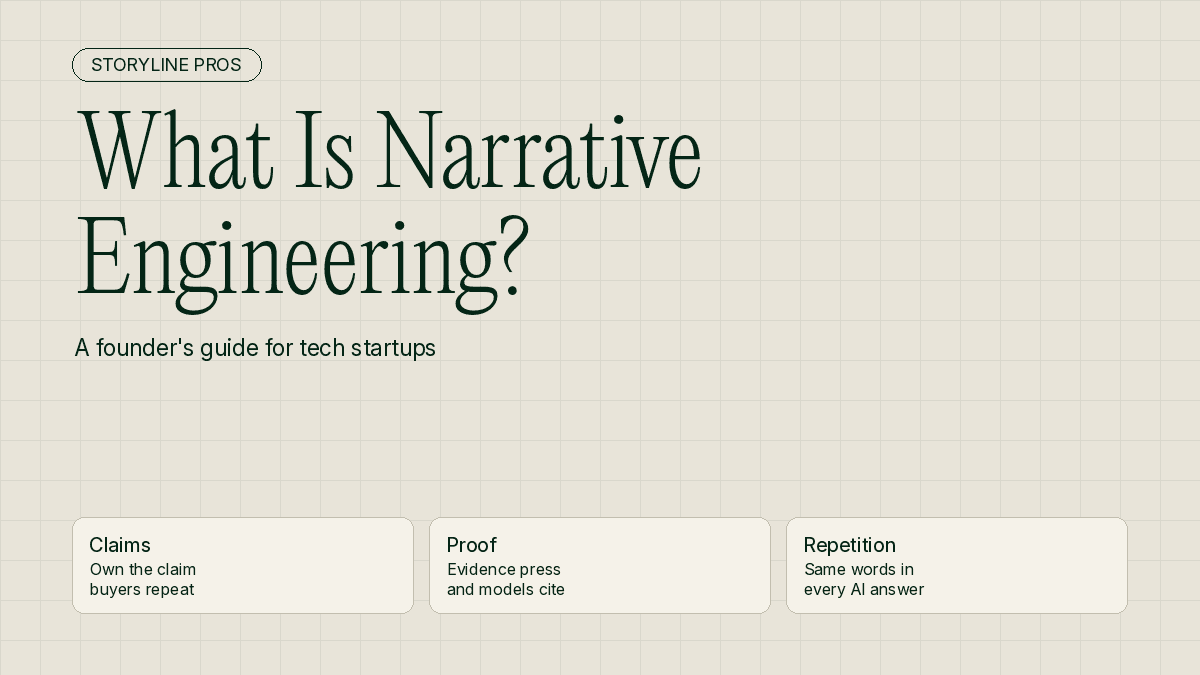
Narrative engineering is the systematic process of optimizing messaging, positioning, and proof so a company’s public story is coherent, newsworthy, and repeatable by third parties (press, buyers, and AI), creating differentiation that drives brand mentions, sales, and investment.
In this article I share why this is the best way to shape buyer perception, create differentiation and lead your category in 2026, and how to do it well.
With product MOATs disappearing, ad costs skyrocketing and competition increasing, your narrative is one of the differentiators left.
I have spent much of my career taking emerging techologies to market and and can tell you how much the narrative matters ( sometimes even more that the tech ).
A few years ago I watched a startup with impressive tech and real science die because its narrative was weak, confusing and not aligned with the market.
One founder said the tech was one thing, another said it was something else, while the website gave a mashup of buzzwords that the ChatGPT wrote.
When it comes to emerging tech, you may have something groundbreaking, but if the narrative is weak you will be left with limited investment and a tough road ahead.
What my years of working in startups have taught me is that adoption for emerging tech is a narrative problem, not a technology problem. Great technology with a weak story dies in the market. And in 2026, that story has to get covered in the media in order to be repeated by a machine.
Today, half of B2B software buyers start their research in an AI chatbot more often than in Google, according to G2's 2026 survey of 1,076 buyers ( in April 2025 it was 29%)
So with buyers not even visiting your website before making a determination your narrative needs to be solid and delivered across an ecosystem of media for anyone to even hear about it via AI search.
Why does narrative engineering matter for startups right now?
For most of the last decade, a startup could lean on a feature competitors did not have. AI coding tools have made that be an unstable way to compete as most software can be copied in weeks.
Once products look alike, buyers fall back on trust and finding the right fit for them. This is confirmed in the latest Gartner's research showing that B2B buying found that buyers spend only 17% of their purchase journey meeting with potential suppliers, and when they compare several vendors, any single one may get only 5% to 6% of that time (Gartner 2017 Digital B2B Buyer Survey, 750 buyers). The study is older, and the preference has grown since. In a 2025 survey of 632 buyers, Gartner found that 61% prefer an overall rep-free buying experience. That leaves your sales team a thin slice of the decision and hands the rest to whatever story is already circulating ( if you even show up as a recommended option ).
AI now shapes a large part of that self-directed research. Forrester reported in January 2026, from its 2025 Buyers' Journey Survey, that 94% of business buyers use AI in their buying process, and that "twice as many buyers named generative AI or conversational search as a more meaningful or important source of information than any other source."
The same study found that 69% of buyers chose a different vendor than they first planned because of an AI chatbot's guidance, and one in three bought from a vendor they had never heard of before. For an early-stage company, that second number is the opening: a buyer who has never heard of you can still choose you, if the answer includes you.
In 2026 AI visibility is an asset that compounds, because it is much harder to copy than your code. But becoming the answer AI recommends is a data driven endevour that starts with a strong narrative and not by a cool new tool that promises the world to you.
Narrative engineering vs storytelling, PR and content marketing
All of this may sound complicated and buzzword so I want to put it simply. Narrative engineering is to storytelling what a race engineer is to driving an F1 car. Storytelling delivers a story but narrative engineering delivers the strategy to win.
| Discipline | The question it answers | What it produces |
|---|---|---|
| Storytelling | How do we tell this well? | A pitch, a keynote, a founder story, an About page |
| Content marketing | What should we publish on our own channels? | Articles, guides, newsletters and posts |
| Public relations | Who will cover us, and where? | Third-party coverage in outlets buyers already trust |
| Generative engine optimization (GEO) | Will AI systems find, trust and cite us? | Citable pages, clear answers and the sources models pull from |
| Narrative engineering | What should the market believe about us, and what proves it? | The claims, frame, proof and vocabulary every other channel works from |
The difference shows up when channels disagree. A startup can have a good founder story, a busy blog and a few press hits and still be described three different ways by buyers, reporters and ChatGPT. Narrative engineering makes those channels say the same thing.
It also considers what AI engines consider authoritative, compartes to competitors positioning and to actual search demand. This more data driven approach is what puts all of the other disciplines together to create an undeniable story that builds trust with buyers, investors and AI platforms.
What does a narrative engineer actually decide?
A narrative engineer makes a short list of decisions most startups leave implicit. They look simple on paper, and getting a founding team to agree on them is the hard part.
- The belief that has to change. Every category has a default assumption that keeps buyers on the status quo. Delivering this as part of your UVP is what makes your brand the one to choose.
- The category frame. Joining, reframing or creating a category changes who you get compared to and which questions you need to win. Niching down at first is the way to dominante and actually be the best for X client.
- The point of view. Your company's opinion on how the problem should be solved, stated plainly enough that a reporter could quote it and a competitor could disagree.
- The proof. Customer results, data, product facts, credentials and third-party coverage that make each claim checkable. A claim without proof does not make the cut.
- The vocabulary. The specific keywords and prompts buyers are using and have actual demand. This is what makes you rank and using the wrong terms is a mistake.
- The boundaries. What you will not claim, which comparisons you avoid, and which audiences you are not for. This honesty makes a difference in building trust.
A hypothetical example:
A seed-stage startup automates security compliance for tech companies. The default belief in its market is that compliance is a once-a-year project you hand to a consultant. The narrative work would name that belief and challenge it positioning itself as the brand for continuous compliance. The brand then backs up every claim to proof a buyer can check, such as audit outcomes, customer quotes and data proving its point. The brand then looks at search demand to find the keywords and phrases buyers search and changes its messaging so those get repeated in its pitch, homepage, press interviews and the pages built to answer buyer prompts.
The company then creates a new category that is security compliance for vibe coders niching down to a growing category that it can win. It then works to get into the relevant media to deliver this narrative and create real newsworthy moments that will get it to stand out.
How Storyline Pros does narrative engineering
My narrative engineering firm Storyline Pros has a proven process we run for every client.
- Category analysis. We map how buyers, competitors, media and AI systems currently describe the problem and the category, including which sources the models already treat as authoritative.
- GEO strategy. We decide which buyer questions and AI prompts the company has to win, mapped across the buyer journey: early questions about the problem, middle questions comparing approaches, and late questions about specific vendors. This is where generative engine optimization planning meets the narrative.
- Narrative engineering. We define the belief that has to change, the category frame, the point of view, the proof, the vocabulary and the boundaries. Each claim gets tied to the prompts it should answer.
- Execution on two parallel tracks. The first track is public relations: news, listicles, tier-one media, podcasts and industry publications. The second is GEO optimization: on-page content and backlinks. Running them together means coverage and owned pages make the same claims at the same time.
- AI visibility reporting. We track whether AI answers and the wider market repeat the intended story, and we adjust the plan based on what moves. Our AI visibility reporting reads the same prompts before and after the work.
The order matters. Teams that start with execution tend to end up with no coverage, or weak coverage tied to no buyer queries that dont really matter.
How does AI search change the job?
Once ChatGPT, Perplexity, Gemini and Google AI Overviews are part of the audience that repeats your story you need to build the credibility that they require.
Entity clarity comes first as models need to know exactly what your company is, what category it belongs to and what it is known for. A clever but vague tagline gives the model nothing to file you under. Models assemble answers from many sources, so a company described differently on its website, LinkedIn and funding announcement creates too much confusion.
Third-party coverage is the proof layer those systems lean on. In an Ahrefs study of 75,000 brands (2025), branded web mentions correlated at 0.66 to 0.71 with brand visibility across ChatGPT, Google AI Mode and AI Overviews, while backlink counts and the number of pages on a site showed weak relationships.
Ahrefs notes that correlation is not causation, but the pattern matches what we see: being discussed across trusted sites does more for AI visibility than publishing more of your own pages. That is why we run PR and GEO as one system. For the tactical side, see our guide on how to get cited by ChatGPT.
Is narrative engineering manipulation?
Some coverage of the term, such as a 2025 IBTimes feature on large consumer brands, describes narrative engineering as a way to control the conversation. That framing makes people nervous, and for a startup it is also impractical. You do not have the budget to control anything, and buyers verify what they read.
The ethical version of narrative engineering is about choosing which true things to emphasize and making them easy to check. We hold every claim to three tests. Is it true today, without footnotes or future tense? Can a buyer verify it through a customer, a dataset, a demo or independent coverage? And does the product back it up when someone actually uses it? A narrative that fails any of them eventually fails in the market, and AI systems that read reviews and coverage will surface the gap.
When does a startup need narrative engineering?
Two or more of these signals usually mean the story is costing you deals.
- You have a raise, a launch or a category claim coming in the next few months, and the story still mostly lives in the pitch deck.
- You have an emerging technology that is new and you are not getting the growth you expected while existing competitors dominate the conversation.
- ChatGPT, AI overviews and other LLMS describes your category without naming you and there is limited information pulled into results when you do a named search.
- You are not a marketer and are having trouble building a positioning and a narrative that can get you the user growth and respect that you now you deserve.
- You have real proof, such as customer results or product data, that never appears anywhere except your own site.
- A competitor with a weaker product gets the coverage and is recommended in AI.
The decision rule: if you have a working product and proof you can defend, but the market describes you poorly or not at all, start with narrative engineering before you spend more on content or PR. If you do not yet have proof, get it first. No narrative holds up without it.
Narrative engineering FAQ
What is narrative engineering?
Narrative engineering is the systematic process of optimizing messaging, positioning, and proof so a company’s public story is coherent, newsworthy, and repeatable by third parties (press, buyers, and AI), creating differentiation that drives brand mentions, sales, and investment.
What is the difference between narrative engineering and storytelling?
Storytelling delivers a story in a specific moment, like a pitch or a keynote. Narrative engineering decides which story is worth telling, what proves it and which words should repeat across every channel. Storytelling is one output of that work.
Do early-stage startups need narrative engineering?
Startups with a working product and some proof usually do, especially before a raise or launch. If you do not define your story, buyers and AI systems describe you from whatever sources exist. Pre-product teams should build proof first.
How does narrative engineering relate to GEO and AI search?
GEO makes a company findable and citable in AI answers. Narrative engineering decides what those answers should say. PR supplies the third-party coverage that models treat as evidence. The three work best together, which is how Storyline Pros approaches narrative engineering.
How do you measure narrative engineering?
Track whether the market repeats your story. Check a fixed set of buyer prompts in ChatGPT, Perplexity, Gemini and Google AI Overviews over time to see whether you are named and described correctly, and compare that with the language prospects use on sales calls.
Where should a founder start?
Your buyers are going to hear an explanation of your category before they ever talk to you. Today a model probably writes the first version of it, from sources you either shaped or ignored. Narrative engineering is how you decide what that explanation says, prove it in places buyers and AI systems trust, and check that it sticks.
If you want to see how your company is described in AI answers today and what it would take to change that, book a strategy session with me. We will look at your category, the prompts that matter for your buyers and where your story is getting lost.