Guide
Build an iconic brand: the brand strategy guide for founders
Brand is a measurable growth engine in 2026. In an AI-saturated market, tactical execution got cheap and distinctiveness got rare. The founders who win lock a clear position, consistent expression, and emotional differentiation that compounds, then stamp it as Brand DNA so people and AI work from one consistent version of the truth. This guide is how you build that Brand DNA document in one sitting: a practical worksheet with the 2026 why woven in through cited sources.
When a founder hands AI a vague brief, the model invents a slightly different company in every draft. The LinkedIn post sounds like a thought leader, the email sounds like a SaaS brochure, and the landing page sounds like a pitch deck that never left the room. Brand DNA is the stamped file that stops that drift. It holds who you serve, what you stand for, how you sound, what you can prove, and what you refuse to say, so people and AI work from one consistent version of the truth before they draft.
You walk out with a Brand DNA Doc, a short AI instructions block you can paste, a handoff anyone new can open, and a five-test loop that catches voice drift before publish. Plan on about two focused hours if you already know the business. Open a blank Doc beside this guide and fill as you go. I run Guide IQ and Storyline Pros from that same stamped file on nikvassev.com work, so the agents, the site pages, and the founder posts stay one company.
01
Why brand is the growth engine in 2026
Threerooms argues that in 2026 brand will outperform performance marketing as the more reliable growth driver, and that strong brands reduce acquisition friction, lift retention, and win attention when AI floods the feed with competent-looking tactics. Their read of the old split is useful: for a decade marketers treated brand as emotional and hard to measure, and performance as immediate and trackable. That divide is collapsing. Brand equity shows up in commercial KPIs when you treat coherence and emotional connection as operating work rather than a mood board.
I keep seeing the cheap-tactics version of this play out in founder feeds. People open ChatGPT, generate the same-looking diagrams and posts that scream ChatGPT, and treat that output as branding. When a post feels inauthentic, out of brand, or out of scope, and the audience clocks the AI, they fully check out. Brands are burning trust they already built by leaning on the model as if it could replace brand and marketing thinking. AI can help as a tool to improve performance, and you leave the positioning, voice, and proof decisions with the humans who own the company, because AI is a prediction machine that averages, and average does not sell. Brand has to be iconic.
Threerooms points to named cases as evidence of the shift. Airbnb cut heavy performance spend and reinvested in brand and PR; the article's takeaway is that when people search for your brand on purpose, you stop paying for every click. Kraft Heinz replaced fragmented regional creative with a unified Brand Growth System anchored on one global platform, "It Has to be Heinz," and Threerooms reports master-brand growth with efficiency from consistency rather than volume. Liquid Death built a distinctive voice in commoditized water and, per that article, reached a $1.4 billion valuation on emotional resonance rather than a better molecule. Mastercard built sonic DNA for payments people cannot see, and Threerooms cites a large trust lift among people exposed to the cue. Mattel's Barbie work under Lisa McKnight treated the brand as a commercial franchise, with the article linking that repositioning to box-office scale and double-digit sales growth. Those are Threerooms' attributions. Use them as pattern recognition rather than your own receipts.
Totem describes a parallel shift in fundamentals: archetypal identity over vague purpose statements, personality over feature positioning, and clarity over tactics. Their point is blunt. Marketing tools and channels got democratized, and AI flattens execution differences in months. What stays scarce is clarity about who you are, who you serve, and what you stand for. Totem also notes that AI search rewards clarity, citability, and original thinking from credible voices. Polished generic copy does not win that surface.
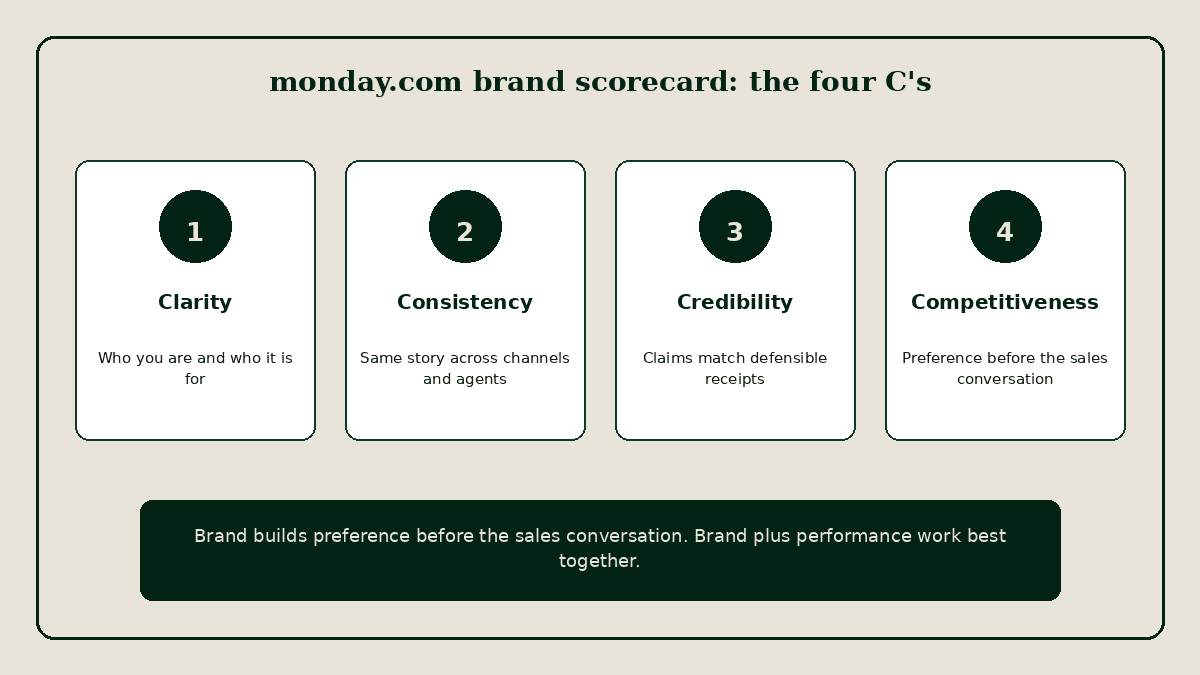
The Unmarketing Agency frames brand strategy as the operating system under the logo: who you are, who it is for, why you instead of the alternative, and how you prove it at every touchpoint. They stress that AI made surface execution cheap, so a position rooted in real market understanding is what remains scarce, and that answer engines treat consistency across independent sources as a reliability signal. monday.com's brand marketing playbook puts the same idea in commercial language: brand builds preference before the sales conversation, and brand plus performance work best together. Their four C's are a clean scorecard if you want one: Clarity, Consistency, Credibility, and Competitiveness. Awesomic lands the practical cut: purpose, values, positioning, identity, and architecture on one page, one archetype fully owned, and AI used for volume with humans guarding voice.
Put those sources together and the founder job in 2026 is clear. Lock a position humans can feel and AI can cite. Keep expression coherent across channels and answer engines. Measure brand with commercial signals rather than vanity. Stamp the decisions so every writer and every agent starts from the same file.
02
Five decisions to lock first
Before you fill worksheets, lock five decisions. Everything in Brand DNA is a capture of these answers for humans and for AI.
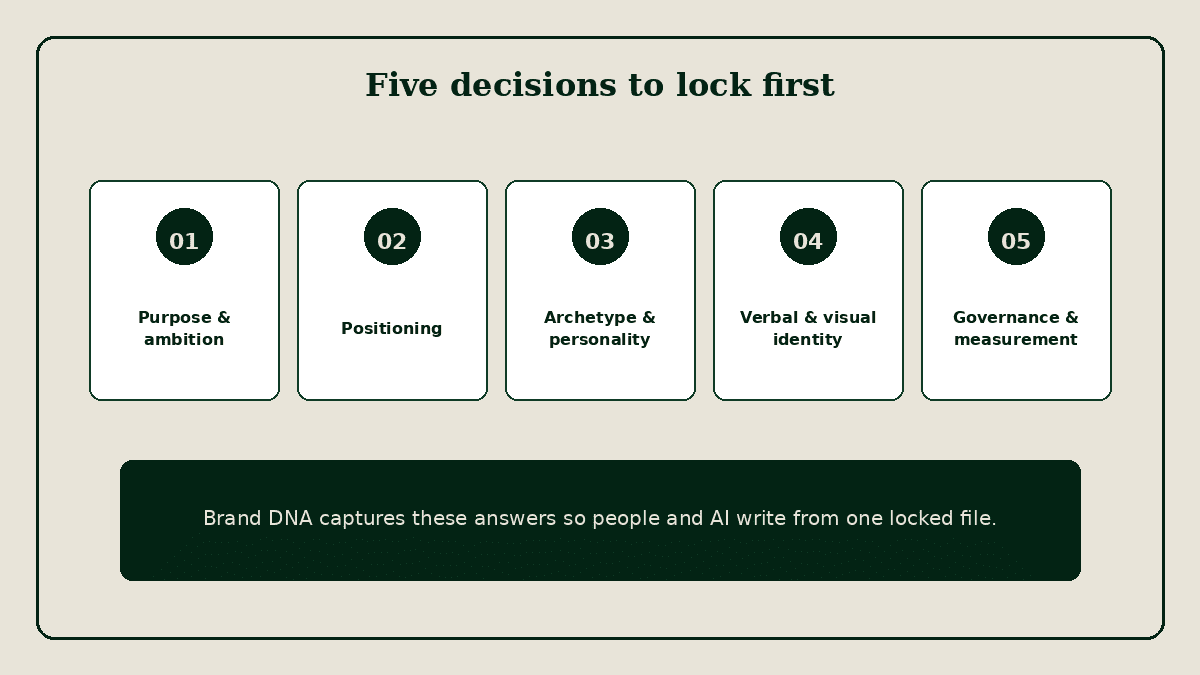
Write one honest line for each. If leadership cannot agree on positioning, stop and settle that fight before you polish voice adjectives. Brand DNA captures those decisions so marketing, sales, freelancers, and agents stop inventing a second company in Slack.
If you want those founder answers structured into brand and go-to-market strategy without a six-week workshop, that is what Guide IQ is for. You answer the questions, Guide IQ builds the brand and GTM brief, and you deploy that document to your agents so they execute from one locked file.
03
What Brand DNA is
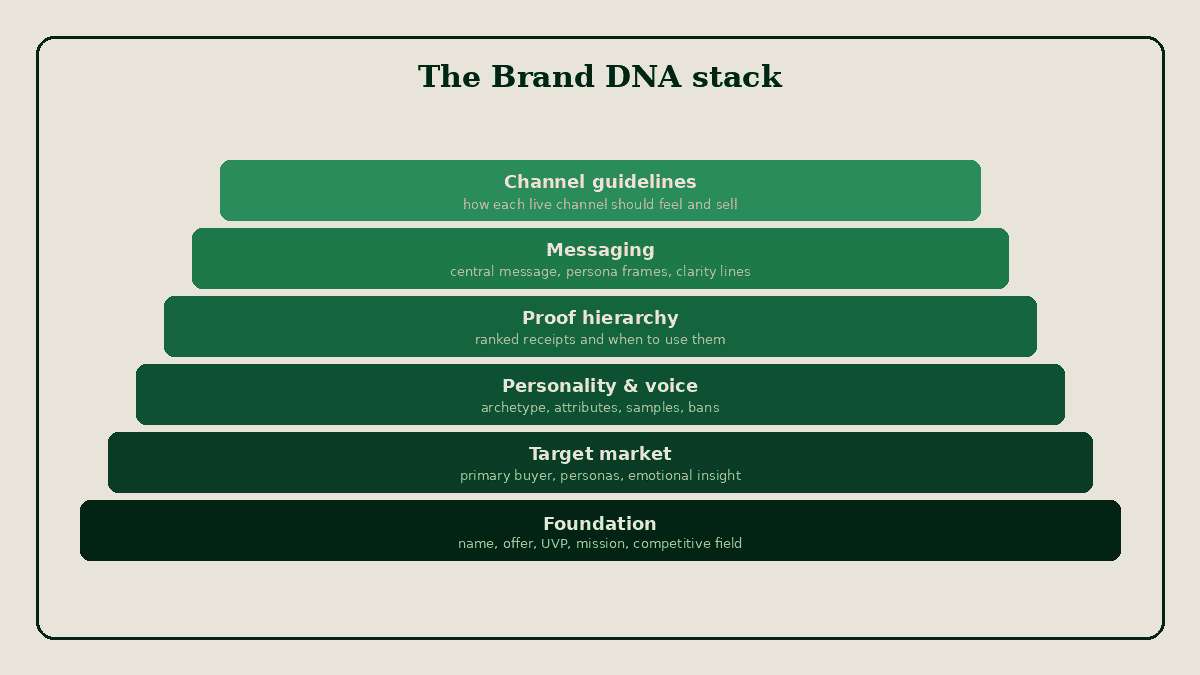
Brand DNA is the strategic brief for your company: foundation, market, voice, proof, messaging, and channel rules in one place. A person or an AI can write on-brand work from it without guessing. Treat it like the brief a senior marketer would demand on day one. Company basics. Who you serve. How you sound. What proof you can use. What you say to each persona. How each channel should feel. Then AI instructions that point at that file as the single source of truth.
This guide teaches the decisions. Your Doc captures the answers. When a section feels thin, strengthen the inputs before you tweak the system prompt. Most bad AI output is a thin DNA problem. The stamped file is also how personal brand work on nikvassev.com and company brand work stay separate when they need to, and aligned when they should share proof and posture.
04
Why Brand DNA matters once AI is writing
AI is fast. Without a stamped story, that speed multiplies inconsistency. Five drafts in an afternoon can mean five versions of your category, your customer, and your claims. Totem's clarity point lands hardest here: models reward a defined identity, and they invent one when you leave a blank.
I see this bottleneck inside real teams. I work with a CEO at a publicly traded company whose roster includes a marketing manager, a social media person, a designer, an ad buyer, and a PR agency. Before Brand DNA, each of them was guessing brand voice and target market on their own. Because the company is public, sensitive claims need CEO approval, so the CEO became the bottleneck for the whole brand. They implemented Brand DNA and built a Brand Brain Custom GPT with a shared link the whole team uses. Now everybody sings from the same songbook, and marketing stays aligned and on brand without every line waiting in the CEO's queue.
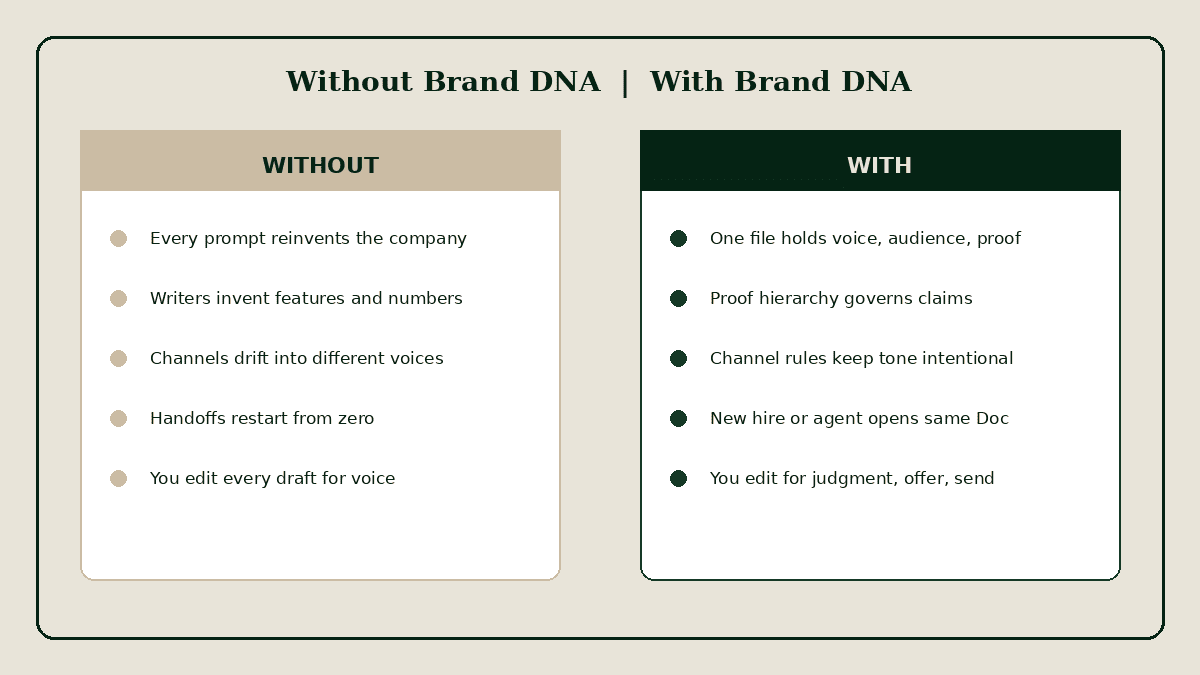
Consistency is the baseline. Precision is next: the right persona, the right proof, the right channel shape. Credibility follows when claims match receipts you can defend. Speed shows up when the AI stops asking who you are. Scale shows up when more people and bots can write without inventing a second brand.
05
What you walk away with
The ongoing win is fewer rewrites and fewer off-brand publishes. Measure your own week against that once the file is live.
06
How to use this guide
Work section by section. Write answers in your Doc as you go. Do not wait for perfect language on pass one. Stamp a usable version, load it into AI, run the tests, then strengthen the weak sections.
01
Read the section
Stay in the current block. Do not skip ahead to voice adjectives.
02
Answer the Write this now prompts
Use your own words. First-pass language is enough.
03
Paste or refine those answers into the Brand DNA document
Stamp a usable version. Perfect sentences come later.
04
Move to the next section
Finish market and proof before you polish voice forever.
05
Add AI instructions and upload the file
Do this only after the document is filled.
06
Run the five tests
Fix the DNA first when something feels off.
Early-stage companies should pick a maximum of three channels to start. Build a real base of readers or leads there before you try to sound native everywhere.
07
Company foundation
This is the spine. Everything else hangs off it. If this section is vague, personas and voice stay vague too.
Company basics
Name, category, what you sell, who pays, how you get paid. Keep it short enough that a stranger could repeat it. If you need a paragraph of caveats to explain the product, the overview is not ready.
Company overview
Write the discovery answers in plain language first. Ask AI to help only after you have raw answers. Use it to tighten language. Do not let it invent a prettier company.
Messaging core
Your UVP is the line a buyer can use to explain the purchase to someone else.
Mission, vision, and values
Mission is the work you do. Vision is the future you are building toward. Values are the rules that settle hard calls. Keep them usable. If a value cannot guide a hire, a cancel, or a public post, rewrite it.
Competitive field
Name the real alternatives: direct competitors, status quo, and DIY. For each, note what they own in the buyer's head and what you own. Competitive positioning later will use this. State what you are and what you are not in short, confident lines.
Write this now
- One sentence: company name, category, what you sell
- Who pays and how you get paid
- Problem in the customer’s words
- What changes for them after they buy
- Product definition (one sentence)
- UVP (what they get / why you / why it matters)
- Competitive frame (how you sit next to alternatives)
- Mission, vision, and 3 to 5 usable values
- Top alternatives: direct, status quo, DIY, and what you own vs them
08
Target market
A brand without a named buyer becomes content for everyone and conversion for no one.
Ideal buyer
One primary buyer first. Role, company stage, budget reality, what they are trying to achieve this quarter. Demo alone is thin. Add the psychographic: what they believe, what they fear, what they are tired of buying.
Personas
Up to five is plenty. Most early companies need two or three. For each persona capture job and context, goals, frustrations, beliefs about the category, purchase moment (what triggers a search or a call), and core emotional driver (what they want to feel true after they buy).
If two personas share the same frustrations and the same trigger, merge them. Distinct emotional drivers are the reason messaging splits later.
Core emotional insight
One sentence that names the feeling under the purchase. The human reason they care, separate from the feature list. Every persona-specific line should point back to that insight without sounding soft or vague. Threerooms' case for emotional differentiation belongs here: algorithms can copy format; they cannot copy a feeling you actually own.
Write this now
- Primary buyer: role, stage, budget reality, this-quarter goal
- Beliefs, fears, and what they are tired of buying
- 2 to 3 personas with job, goals, frustrations, beliefs, purchase moment, emotional driver
- One-sentence core emotional insight for the company
- Merge note: any personas that should collapse into one
09
Personality and voice
Personality is who the brand is. Voice is how it talks. Tone is how voice flexes by situation.
Archetype
Totem's 2026 shift is useful here: stop collecting vague purpose lines and pick one archetypal identity you will actually own. Magician, Sage, Creator, Ruler, Caregiver, and the rest are labels. The useful part is the behavior: what that archetype would say, refuse, and emphasize. Write three lines of behavior rather than a mythology essay. Awesomic makes the same operator point with Jung's twelve archetypes. Pick one core. A brand that tries to be heroic, caring, and rebellious at once reads as having no personality.
Voice attributes
Three to five adjectives with a one-line definition each. Calm confidence. Specific. Direct. Whatever is true for you. Pair each with a short do and don't so AI has an edge to follow.
Tone variations
Same voice, different rooms. A support email is warmer than a homepage. A LinkedIn post can carry more point of view than a press release. Write the shift in one sentence per channel family so the AI does not flatten everything into the same cadence.
Voice examples
Paste three to five real paragraphs that already sound like you: a founder note, a sales email that worked, a bio you would stand behind. These beat any adjective list. Point AI at the samples.
Voice comparison
Show a weak line and a strong rewrite for the same idea. Generic versus stamped. Soft claim versus receipt. This trains the model faster than another adjective.
Banned words and phrases
List the words that make you sound like every other startup, plus the phrases that violate your posture. Add a one-line why next to each. When AI slips, expand this list. Fix the DNA rather than only scolding the draft.
Write this now
- Primary archetype + three behavior lines (say / refuse / emphasize)
- 3 to 5 voice attributes with definition, do, and don’t
- One-sentence tone shift for email, social, long-form, ads, PR
- 3 to 5 pasted samples that already sound like you
- One weak line vs one strong rewrite for the same idea
- Banned words/phrases with a one-line why for each
10
Proof hierarchy
Proof is the conversion layer. Voice without proof is style. Proof without a hierarchy becomes a dump of logos and numbers on every post. Unmarketing's fourth question lives here: how do you prove the difference every time someone meets you.
Rank the proof
Rank strongest to weakest for your company. A typical order:
- Named outcomes with numbers you can defend
- Customer stories with permission
- Third-party coverage and research you are actually in
- Partnerships and credentials that matter to the buyer
- Process or method proof (how you work)
- Founder story, used sparingly and only when it proves the claim
Tell the AI when to use proof. Conversion pages, sales notes, and offer posts need it. General awareness can stay lighter. Add that rule in the DNA so every social post does not open with a trophy shelf.
Testimonials
Capture name, role, company, the exact line, and the claim it supports. Store permission status. A testimonial without a claim link is decoration.
Proof library
Keep a living shelf: case notes, metrics, quotes, media links, FAQs. Update it when the business changes. Point AI at the shelf. Never invent a partner, a number, or a quote that is not in the file.
Write this now
- Your ranked proof list (strongest to weakest)
- Rule for when proof is required vs optional
- At least two testimonials with name, role, line, claim link, permission status
- Proof shelf links or notes: cases, metrics, quotes, media, FAQs
- Claims you will never make because you cannot defend them
11
Messaging
Central brand message
One line that carries the company across rooms. It should survive a homepage, a cold email, and a founder intro. If it only works in a pitch deck, keep writing.
Persona-specific messaging
For each persona, write the frame that matches their beliefs, frustrations, and desires. Keep voice constant. Change the hook and the proof, leaving the identity of the company intact. When you ask AI to draft these frameworks, feed it the company overview, messaging core, mission set, target market, proof points, and brand voice.
Competitive positioning messages
These are short clarity lines. What you are. What you are not. A sentence a customer instantly understands. This is separate from the UVP. UVP sells the value. Positioning clears the confusion next to alternatives and misconceptions.
Keep statements short and confident. No buzzword fog. Tie each line to a defensible advantage from your competitive field section.
Once messaging is on the page, the next job is distribution and GTM. Guide IQ turns the same founder answers into brand plus go-to-market strategy you can hand to agents, so ads, email, founder posts, and outreach all read from one locked document instead of inventing a new company every week.
Write this now
- Central brand message (one line)
- Persona frame for each persona: hook, belief it meets, proof to use, CTA shape
- What you are / what you are not (short clarity lines)
- One misconception you need to kill in public copy
12
Channel guidelines
Your brand stays itself across channels. Structure and tone adapt to how people consume each platform. Review best practices for email, social, blogs, ads, and PR, then rewrite them so they sound like your company.
Strong channel guidelines stop drift. They also stop AI from turning every LinkedIn post into a blog and every email into an ad.
If you are early, pick three channels maximum. Build subscribers, conversations, or pipeline there. Spreading thin is how founders stay busy and still invisible. Coherence beats channel volume, which is the same commercial point Threerooms and monday.com make when they put brand and performance on one operating system.
Write this now
- Your three channels for the next 90 days
- For each: subject/hook posture, length, CTA style, sell intensity
- One “do not” per channel (example: LinkedIn is not a pitch deck dump)
- Where ads and PR wait until the first three channels have a base
13
Load Brand DNA into AI
Upload the Brand DNA as a knowledge file wherever you write. Attach supporting docs: guidelines, product lists, case studies, proof shelf, decks, FAQs. Update quarterly or when the offer changes. Awesomic's practical rule fits: AI for volume, humans for the emotional and brand-risk calls.
Two common setups from the Brand DNA system:
You do not need both. Together they give you a strategic brain and a daily execution partner. If you run named agents in Grok Bot, drop the same Brand DNA file in Drive and tell every writing bot to open it. Do not paste a summary into the agent description and hope. The file is the source of truth.
The public-company Brand Brain pattern is the Custom GPT path at team scale: one shared link, Brand DNA loaded as knowledge, and every marketing seat reading from the same brain. That is how a marketing manager, social lead, designer, ad buyer, and PR agency stay on voice without sending every draft through the CEO for tone.
Claude Project setup
01
Open Projects in Claude
02
Create a new project
Name it like Your Company Marketing Strategist.
03
Paste the AI instructions
Put them in project instructions.
04
Upload Brand DNA and supporting documents
05
Run a first prompt
Refine the DNA when the output drifts.
Custom GPT setup
01
Create a GPT in ChatGPT
02
Set name, description, and photo
03
Paste the AI instructions
04
Upload Brand DNA and supporting documents
05
Choose the latest model, create, and share
Share with the team by link if needed.
06
Run a first prompt and refine
Grok Bot / Drive setup
01
Put the Brand DNA Doc in Drive
Use the folder your bots can open.
02
Point every writing bot at that file
Do it in Talk or standing rules.
03
Tell the bot to open the file
Do not ask it to invent from memory.
04
Update the Doc when the offer or proof changes
The bots read the live file.
If the worksheet still feels heavy to build from a blank page, run the company through Guide IQ first. Answer the questions, get the brand and go-to-market strategy, then load that stamped brief into Claude, a Custom GPT, or your Grok Bots the same way.
14
AI instructions to paste
You are [Your Company]’s lead marketing strategist and copywriter. Your role is to create clear, compelling, on-brand marketing and sales content across all channels. You always follow the Brand DNA document as the single source of truth for voice, audience, proof, and messaging.
Knowledge: You have access to the Brand DNA worksheet and any supporting materials uploaded. Always reference that knowledge when writing. If something is not defined, ask for clarification or make a reasonable assumption and flag it. Never contradict the Brand DNA. Do not invent offers, features, pricing, or proof that are not provided.
Content you create: email, blogs, social, paid ads, short-form video scripts, PR, website and funnel copy, sales materials.
How to write: Match the brand voice, archetype, and tone in the Brand DNA. Write to the correct persona for the request. Use proof according to the proof hierarchy. Never fabricate numbers, partners, or testimonials. Follow channel guidelines for structure and length. Avoid banned words. Prioritize clarity, specificity, and utility.
Workflow: Before drafting, silently review which persona, channel, and goal apply. If the request is vague, ask one or two focused questions. Deliver ready-to-publish drafts unless the user asks for an outline. Suggest hook, subject, or CTA variations when helpful.
Your goal is to behave like a senior marketing partner, creating consistent on-brand content that could ship with light human edit.
Write this now
- Paste the AI instructions into your Claude Project, Custom GPT, or Grok Bot standing rules
- Upload or link the Brand DNA file
- Attach proof shelf and 2 to 3 writing samples
- Run one test prompt before you trust it for live work
15
Test and refine
Before you trust the system for real publishes, run five quick checks.
When something feels off, update the Brand DNA worksheet first. That is the master file. You rarely need to rewrite the AI instructions. Most fixes belong in the DNA.
Write this now
- Run all five tests and paste pass/fail notes into the Doc
- For each fail, edit the matching DNA section before you change instructions
- Schedule a quarterly DNA refresh when the offer or proof changes
16
Stamp the story before you scale
Fill the foundation, name the market, lock voice with real samples, rank the proof, write the central message and the persona frames, pick three channels, load the file into AI, run the five tests, and strengthen the DNA when a draft drifts. Stamping that story is founder work you do before you scale agents and content volume. Without DNA, agents invent a category and writers invent a second brand. The stamped file is how marketing, sales, freelancers, and bots stay on one company. In 2026 that file is also how you stay coherent when answer engines, ads, and founder posts all speak at once.
Once the file is live, your job shifts. You edit for judgment, offer, and send. The stack stops asking who you are every morning. That is also how you avoid the ChatGPT-average trap: the model will still draft fast, but it drafts from a locked story instead of inventing a generic company that burns trust. AI stays a tool for performance. Brand stays iconic because the thinking stayed yours.
If you want the structured founder inputs turned into a stamped Brand DNA and go-to-market strategy without building the worksheet from scratch, that is what Guide IQ is for. Answer the questions, lock the strategy, deploy it to your agents, and scale content only after the story is fixed. If you want the weekly operator version of how I run this, that is Systems Over Hustle.